Should our elected school board fight back?

The tricky question is:   Should our elected school board fight back like the Leon County School Board did?

Excerpt from article:

After a lengthy debate, the Leon County School Board denied a new charter school’s application during Tuesday night’s board meeting. Scott Mazur, president of the local teacher’s union, said the charter’s application had “certain things that were missing.” George Levesque, attorney for the proposed school, said he hoped the board would consider “the recommendation made by your own staff — that the charter should be approved [despite the concerns].” Among several concerns laid out by staff  was how the school would maintain a safe school officer, required by law [for both district run and charter schools].

https://www.tallahassee.com/story/news/2021/04/28/leon-county-school-board-denies-red-hills-academy-charter-application/4863727001/

I encourage the school board to adopt a policy that states that they will deny all charter school applications that do not include the following:         
* Give assurance that the charter school will accept and have adequate support for ESE students
* Fully explain the charter school’s plan to comply with the state law that requires a school safety officer with a gun to be at the school. Do they plan to allow teachers to be armed which the school district doesn’t allow for the district run schools?
* When the charter school closes, the building purchased or constructed with taxpayer dollars (either directly or indirectly via lease payments) must be leased to another charter school or allow the school district to share in the sales proceeds to recoup the tax money if the building is sold. After all, if the charter school is planning to fund the purchase with our sales surtax dollars, the school district should be able to have the ability to recoup our sales surtax dollars. Apparently the FLDOE thinks that also.

My guess is that most taxpayers don’t want our sales surtax money to fund the purchase of a school building that will later be sold to a private school for the purpose of enriching private real estate investors.

I asked the FLDOE these questions and here are the responses I received:

1. Is there any provision to pay the taxpayer back if the building is sold? Their answer:

Section 1013.62 (4) F.S. states, “If a charter school is non-renewed or terminated, any unencumbered funds and all equipment and property purchased with district public funds shall revert to the ownership of the district school board. The reversion of such equipment, property, and furnishings shall focus on recoverable assets, but not on intangible or irrecoverable costs such as rental or leasing fees, normal maintenance, and limited renovations. The reversion of all property secured with public funds is subject to the complete satisfaction of all lawful liens or encumbrances. If there are additional local issues such as the shared use of facilities or partial ownership of facilities or property, these issues shall be agreed to in the charter contract prior to the expenditure of funds.”

http://www.fldoe.org/core/fileparse.php/7716/urlt/Distribution-of-Charter-School-Capital-Outlay-Funds-for-2020-21-FY.PDF

2. Do related party rules apply so that our sales surtax money can ONLY be used (directly or indirectly via lease payments to a related party) on items mentioned in 1013.62(4)? In other words, can related parties use our sales surtax money to repay loans? It seems that charter schools are setting up related party entities to skirt the rules of 1013.62(4) that bar capital outlay funds from being used to repay loans. Is that legal?  Their answer:

The sponsor has fiduciary responsibility as it holds the contract with the governing board of the charter school.

An excerpt from 1002.33

[The applicant must disclose ] the name of any charter school operated by each applicant, each governing board member, and each proposed education services provider that has closed and the reasons for the closure; and the academic and financial history of such charter schools, which the sponsor shall consider in deciding whether to approve or deny the application.
http://www.leg.state.fl.us/statutes/index.cfm?App_mode=Display_Statute&Search_String=&URL=1000-1099/1002/Sections/1002.33.html

References
I’m focusing on one charter school as an example but many of these facts can be applied to other charter school applications.


Jacksonville Classical Academy (K-6) with the FLDOE school number165831 hasn’t been in existence for two years so it has not yet begun to get the FLDOE capital outlay funds detailed on this website:  http://www.fldoe.org/finance/fco/charter-school-capital-outlay/

Jacksonville Classical Academy (which is part of the national charters getting their curriculum from Hillsdale College) got another Charter school approved May 4th by the school board. And apparently the charter school plans to move into a facility that housed a private school that closed in 2019.
Excerpt from a document about the charter school’s application found on the school board’s website.:  

“The school will be located in the Arlington area at 5900 Fort Caroline Road, Jacksonville, FL 32277.”

This article mentions that many of the students that attended the private school that closed (and is apparently the proposed location of the new charter school) were at least partially funding their tuition with McKay (for ESE students) vouchers. Excerpt from this 2019 article:

The principal of a Christian school in Arlington said financial issues due to low enrollment will force it to close its doors May 31 — the end of the current school year. Arlington Community Academy has been open for two years, opening as a kindergarten through third grade, and then adding a fourth grade this year. “He made a commitment to us that he would keep this school open for the Arlington community and he’s not doing that,” the unnamed parent said. “Within three years, he’s shutting down and he’s not telling us nothing.” “Enrollment is critical to maintaining operations,” Principal Gina Fafard wrote. “Despite our best efforts, enrollment has been significantly lower than expected, and we are not able to keep ACA operational beyond the end of the 2018-2019 school year.”

https://www.news4jax.com/news/2019/03/22/arlington-christian-school-tells-parents-it-will-close-in-may/

Some of the deficiencies in the charter school application concerned ESE students. Link to evaluation form that was found on the school board’s website:
https://civicclerk.blob.core.windows.net/stream/DUVALCOSB/ff97777bdf.pdf?sv=2015-12-11&sr=b&sig=4bEVy%2B6arEBODObA9REtTCtC9TkQ7Dx8SlrPKHQ08nU%3D&st=2021-05-05T23%3A01%3A16Z&se=2022-05-05T23%3A06%3A16Z&sp=r&rscc=no-cache&rsct=application%2Fpdf&fbclid=IwAR3cvkDmkYmv0mQuFny7HfHej2m6chg8ExLxwj-rAbdIkC9ugVbygFIeD-8

I assume real estate investors will buy the facility and lease it to the charter school because that’s usually what happens. The charter school will make the lease payments with our sales surtax dollars and other tax dollars.  Will the real estate developers sell the property back to a private school after they get our sales surtax dollars for several years? The Jacksonville Classical Academy on 2043 Forest St., 32204 leases its building from JEB Jacksonville Support Corporation. Details of that real estate investor group: 
https://opencorporates.com/companies/us_fl/N19000011884

Quote from this November 2020 opinion piece published after the sales tax referendum was passed: 

Rood said that Jacksonville Classical Academy will benefit from the recent half-cent sales tax referendum. Funds will be used to build a gym and free the school from some fundraising.

 https://www.jacksonville.com/story/opinion/editorials/2020/11/29/editorial-new-charter-school-looks-like-classic-success/6373373002/

I see that the new KIPP school is requesting to be designated as a feeder school so it can get our sales surtax money BEFORE the two year probation period. Will this new charter school attempt to be designated as a feeder school also?

Anyone want to comment about Critical Race Theory and the propaganda pamphlet I received from Hillsdale College? Excerpt I received from a public request I sent to Jacksonville Classical Academy:

Jacksonville Classical Academy (JXC) has been supported through the early stages of startup by the Barney Charter School Initiative (BCSI) of Hillsdale College. Jacksonville Classical Academy is a Licensed User of the Hillsdale College K-12 Curriculum.

This blog post is about Hillsdale College and Critical Race Theory: 
https://uniteusdonotdivideus.com/2021/05/01/critical-race-theory/

2015 article but this is still true:

A recent spate of charter-school closings illustrates weaknesses in state law. Florida requires local school districts to oversee charter schools but gives them limited power to intervene when cash is mismanaged or students are deprived. Lack of regulation can allow abuses.  …  A handful of South Florida charter schools that failed in the past five years owe a total of at least $1 million in public education money to local school districts, records show. The actual amount may be much higher. Districts struggle to track spending at troubled schools.

http://interactive.sun-sentinel.com/charter-schools-unsupervised/investigation.html

How much PECO funds did Duval County Charter Schools receive in April 2021?

When I asked the FLDOE if these were PECO funds of which I believe the district run schools got zero, this was the response:

Per the 2020 General Appropriations Act, Chapter 2020-111, specific appropriation 21, these capital funds are from the Public Education Capital Outlay and Debt Service Trust Fund (state funds).   

These Duval County charter schools received capital outlay funds from the state every month this year.  The amount received for April:

AprilName of charter school
15,090160471LONE STAR HIGH SCHOOL
8,338160531DUVAL MYCROSCHOOL OF INTEGRATED ACADEMICS AND TECHNOLOGIES
4,823161021SCHOOL OF SUCCESS ACADEMY-SOS
7,060161131WAYMAN ACADEMY OF THE ARTS
36,014161201RIVER CITY SCIENCE ACADEMY
9,919161211TIGER ACADEMY
66,154161221GLOBAL OUTREACH CHARTER ACADEMY
29,932161231DUVAL CHARTER SCHOLARS ACADEMY
19,197161251SOMERSET ACADEMY-ELEMENTARY, EAGLE CAMPUS
10,394161261SOMERSET ACADEMY-MIDDLE, EAGLE CAMPUS
107,446161271KIPP VOICE / KIPP IMPACT K-8
26,947161291RIVER CITY SCIENCE ELEMENTARY ACADEMY
25,028161311DUVAL CHARTER HIGH SCHOOL AT BAYMEADOWS
52,537161321DUVAL CHARTER AT BAYMEADOWS
6,078161331WAVERLY ACADEMY
24,544161371SEACOAST CHARTER ACADEMY
31,866165381SAN JOSE PREP
17,215165401SEASIDE COMMUNITY CHARTER SCHOOL
39,629165411DUVAL CHARTER SCHOOL AT WESTSIDE
8,535165421BISCAYNE HIGH SCHOOL
23,158165441RIVER CITY SCIENCE ACADEMY INNOVATION SCHOOL
34,614165511DUVAL CHARTER SCHOOL AT MANDARIN
49,009165551DUVAL CHARTER SCHOOL AT SOUTHSIDE
43,475165591DUVAL CHARTER SCHOOL AT FLAGLER CENTER
37,139165601RIVER CITY SCIENCE ACADEMY AT MANDARIN
16,461165611BRIDGEPREP ACADEMY DUVAL COUNTY
49,728165621DUVAL CHARTER SCHOOL AT COASTAL
20,989165631SEASIDE CHARTER K-8 SCHOOL
23,256165731GLOBAL OUTREACH CHARTER ACADEMY HIGH SCHOOL
7,827165761SAN JOSE PRIMARY SCHOOL

The above information is from this website:
http://www.fldoe.org/finance/fco/charter-school-capital-outlay/

New charter schoolsThey need to be in existence 2 years to get capital outlay funds OR qualify as a feeder
165801Cornerstone Classical Academy (K-6)Approved in 2019 or 2020
not opening until 2022Global Outreach Charter Academy High School (9 – 10)Approved in 2019 or 2020
165831Jacksonville Classical Academy (K-6)Approved in 2019 or 2020
165711Seaside Charter North CampusApproved in 2019 or 2020
165791Seventh Generation Classical Academy at Mandarin Approved in 2019 or 2020
trying to get money early as a feeder schoolKIPP Jacksonville HS Approved in 2019 or 2020
165841River City Science Academy Intracoastal Approved in 2019 or 2020
not opening until 2022Global Outreach Intercoastal Approved in 2019 or 2020
not opening until 2022River City Science Academy Southeast Approved in 2019 or 2020
not opening until 2022San Jose North Approved in 2019 or 2020
165871Becoming Collegiate AcademySchool board approved January 2021
RIVER CITY EDUCATION ORGANIZATION, INC., TO OPEN SAN JOSE CYBER ACADEMYSchool board approved March 2021
GLOBAL ARTS ACADEMYSchool Board approved May 2021
JACKSONVILLE CLASSICAL ACADEMY EASTSchool Board approved May 2021

What is the future of charter schools?

It’s interesting to read the 2012-2013 study. My comments are in red. Everything else is from the study at this link:
https://lwvfl.org/wp-content/uploads/2021/03/issue-education-studies-actions-statewide-school-study.pdf

This ship has left the port, eh? Is there any chance of giving the school district this kind of flexibility?

  • Districts must identify unmet student and community educational needs as part of their strategic plans and submit priorities for alternative and/or charter schools to the Florida Department of Education.
  • Only charter schools that offer identifiable innovative teaching/learning methods or meet specific unmet needs should be authorized.
  • Districts must identify unmet student and community educational needs as part of their strategic plans and submit priorities for alternative and/or charter schools to the Florida Department of Education.
  • Only charter schools that offer identifiable innovative teaching/learning methods or meet specific unmet needs should be authorized.

These seem like ideas we should be able to advocate for:

  • A charter school governing board must have a minimum of one local representative, not the administrator, who resides in the community and is answerable to the school parents and community.
  • Those charter schools that educate students requiring ESE services must hire appropriately certified full or part time instructors before applying for additional funding for the services. 
  • Charter schools must report teacher and student retention.
  • The charter school audit template must be adequate for comparison and analysis and identify facilities ownership and management contractors.
  • Teachers and administrators, including principals, must meet certifications and qualifications at the same level as all other public school instructors or administrators.
  • All schools, even small ones, receiving state funds must report state assessment test scores, and receive some indicator of student achievement levels.
  • Administrators and board members of all public schools, including charters, must not supervise or determine compensation for family members.
  • Members of charter school governing boards must not have financial interests in the charter school.
  • Legislators serving on education or appropriation committees must recuse themselves on votes related to charter school finance if they have financial interests in charter schools.
  • As a recipient of public education funds, charter schools should be required to meet the same procurement requirements as other public institutions, including competitive bids for leasing, acquisition of sites and purchasing of supplies, equipment and facilities. The records should meet all public records laws for full disclosure.
  • Charter schools that acquire their facility using public funds must assure that the facility reverts to public ownership at the termination of the charter. If a facility is subject to a mortgage to be paid using public funds, the mortgage must disclose and protect the public’s interest in the facility.

These should be monitored by the FLDOE not the local school district staff.  The school district has enough on their plate especially if they don’t get the funds for the administrative staff to do this or the ability to deny charter school applications.

  • Charter school admissions and dismissal policies and procedures should be supervised by district staff to ensure they conform to state guidelines.


Has your view changed over time?  

How do you view charter schools? One of these two choices or another way?

Quote from ref 1:

The story goes something like this. In 1988, Albert Shanker, legendary president of the American Federation of Teachers (AFT), gave a speech at the National Press Club where he outlined his vision for a new kind of publicly funded, independently managed school. He called them “charters” and saw them as educational laboratories, where teachers could try out new pedagogical approaches. By empowering teachers to experiment with their craft, charters could serve as R&D spaces for new and better practices that could then be transferred back into traditional public schools. In a New York Times column published later that year, Shanker carried his ideas to the wider public.

Quote from ref 2:

Charter School Purpose: The purpose of charter schools is to serve unmet needs with a primary focus on low income families, reading, and innovative instructional methods. Local needs are best identified by the local school district as part of its strategic plan. To avoid inefficiency through duplicative programs or to avoid insufficient funding for either program to be successful, charter schools should serve as a complement to, not a competitor of, traditional public schools.

Quote from ref 3

Charter schools were intended to be centers of education experimentation and innovation, but they generally neither invent new teaching methods nor develop and spread new education practices. They’re businesses first, and schools second.

https://networkforpubliceducation.org/privatization-toolkit/

Ref 1 is a great article and worth the read.

Ref 2 is to the League of Women Voters-Florida study

http://files.ctctcdn.com/9e023c2e001/312a667d-ca9e-4dc6-be72-3eb1d9d47c25.pdf

It was referenced in this article. Excerpt from article:

RAVITCH: Florida is one of the most corrupt states in the country when it comes to education. I’ve read the reports of a group called Integrity Florida, which is a government ethics watchdog. I read the reports of the Florida League of Women Voters, and when they write about charter schools, they write about the blatant conflicts of interests of the people in the Florida Legislature

In New Book, National Education Historian Calls Florida ‘Model Of Lawlessness And Greed’

Ref 3 is Toolkit: School Privatization Explained


https://networkforpubliceducation.org/privatization-toolkit/

Critical Race Theory

IMHO Corcoran and Rufos are being deceitful by redefining CRT rather than inventing a new term for what they mean. Excerpt from the Learning for Justice (Teaching Tolerance) article:

“These new bills banning CRT don’t have all that much to do with actual critical race theory.”

https://www.learningforjustice.org/magazine/what-critical-race-theory-is-and-what-it-means-for-teachers

Terms (that have existed for decades) should not be redefined as was done in this Florida state Board of Education regulation that was promoted by Governor DeSantis and Education Commissioner Corcoran:

Excerpt from regulation: “Critical Race Theory, meaning the theory that racism is not merely the product of prejudice, but that racism is embedded in American society and its legal systems in order to uphold the supremacy of white persons.”

https://www.flrules.org/gateway/readFile.asp?sid=0&tid=24754999&type=1&file=6A-1.094124.doc

Link to how the regulation 6A-1094124 has changed over the last few years:

https://www.flrules.org/gateway/ruleno.asp?id=6A-1.094124

Corcoran says beginning around minute 37 in the video (See link below):
So we rewrote all of our standards, … so now the books have come back … but I didn’t think to say “okay and keep all of the crazy liberal stuff out” and … they hide it in “social emotional learning” so it doesn’t SAY “Critical Race Theory” … now we have to go back and say, if it’s electronic, we want it out and, on top of that, we’re passing a rule this coming month that says, for the 185,000 teachers, you can’t indoctrinate students with stuff that’s not based on our standards, the new B.E.S.T. standards. But you have to police it on a daily basis … I’ve censored or fired or terminated numerous teachers for doing that. I’m getting sued right now in Duval County … because it was an entire classroom memorialized to Black Lives Matter… we made sure she was terminated

Corcoran says beginning around minute 29 in the video (see link below):
If we can get Education right, we can have kids be literate and then understand what it means to be a self-governing citizen in a self-governing country, we’ll win it back. … Education is our sword, you know …

Link to video of Education Commissioner Corcoran

What does Hillsdale College and Education Commissioner Corcoran mean by Critical Race Theory?

I don’t know how but I have been placed on a mailing list to get propaganda from Hillsdale College. The most recent one had the headline: “Critical Race Theory: What It Is and How to Fight it.” I’m saving the flyer in case anyone wants to see it.

As a rebuttal to the Hillsdale College propaganda flyer, I offer excerpts from a couple of articles :

Crenshaw notes that CRT is not a noun, but a verb. It cannot be confined to a static and narrow definition but is considered to be an evolving and malleable practice. It critiques how the social construction of race and institutionalized racism perpetuate a racial caste system that relegates people of color to the bottom tiers. CRT also recognizes that race intersects with other identities, including sexuality, gender identity, and others. CRT recognizes that racism is not a bygone relic of the past. Instead, it acknowledges that the legacy of slavery, segregation, and the imposition of second-class citizenship on Black Americans and other people of color continue to permeate the social fabric of this nation. 

Mari Matsudi described CRT as the work of progressive legal scholars seeking to address the role of racism in the law. CRT grew from Critical Legal Studies (CLS), which argued that the law was not objective or apolitical. CLS was a significant departure from earlier conceptions of the law (and other fields of scholarship) as objective, neutral, principled, and dissociated from social or political considerations. Like proponents of CLS, critical race theorists recognized that the law could be complicit in maintaining an unjust social order. 

CRT calls for considering unintended consequences of proposed remedies, addressing intersecting policies and structures, and acting intentionally to ensure that harm is not further replicated by the legal system.

Like any other approach, CRT can be misunderstood and misapplied. It has been distorted and attacked. And it continues to change and evolve. The hope in CRT is in its recognition that the same policies, structures, and scholarship that can function to disenfranchise and oppress so many also holds the potential to emancipate and empower many. It provides a lens through which the civil rights lawyer can imagine a more just nation.
https://www.americanbar.org/groups/crsj/publications/human_rights_magazine_home/civil-rights-reimagining-policing/a-lesson-on-critical-race-theory/

Critics of these efforts warn that the bills [that seek to ban Critical Race Theory from being taught in schools] would effectively prevent public schools and universities from holding discussions about racism; the New Hampshire measure in particular would ban companies that do business with government entities from conducting diversity, equity, and inclusion programs…The larger purpose, it seems, is to rally the Republican base—to push back against the recent reexaminations of the role that slavery and segregation have played in American history and the attempts to redress those historical offenses. The shorthand for the Republicans’ bogeyman is an idea that has until now mostly lived in academia: critical race theory....The theory’s proponents argue that the nation’s sordid history of slavery, segregation, and discrimination is embedded in our laws, and continues to play a central role in preventing Black Americans and other marginalized groups from living lives untouched by racism. …Conservatives are not the only critics of diversity training. For years, some progressives, including critical race theorists, have questioned its value: Is it performative? Is it the most effective way to move toward equity or is it simply an effective way of restating the obvious and stalling meaningful action? But that is not the fight that has materialized over the past nine months. Instead, it is a confrontation with a cartoonish version of critical race theory.
https://www.theatlantic.com/politics/archive/2021/05/gops-critical-race-theory-fixation-explained/618828/

MONICA BELL: I think both are true. Across the spectrum, saying that America is racist is read by people saying that Americans are racist. We don’t have a good way in our society of thinking about the difference between structural and systemic racism and individual racism. This is the big problem.
https://www.politico.com/newsletters/the-recast/2021/05/04/america-racism-politicians-response-492718

Vice President Kamala Harris said America is not a “racist country” but the nation must “speak the truth” about its history with racism on ABC News’ “Good Morning America” on Thursday. “One of the greatest threats to our national security is domestic terrorism manifested by white supremacists,” Harris said, referencing reports from federal law enforcement and intelligence agencies identifying white supremacists as a persistent and rising terror threat. “And so these are issues that we must confront, and it does not help to heal our country, to unify us as a people, to ignore the realities of that,” the vice president said. “The idea is that we want to unify the country but not without speaking truth and requiring accountability where it is appropriate,” she urged.
https://www.usatoday.com/story/news/politics/2021/04/29/kamala-harris-responds-tim-scott-saying-america-not-racist-country/4886682001/

Gov. Ron DeSantis has said he is adamant that Critical Race Theory not be taught in public schools. [Why? Is it just whistle blowing to a racist base?]?

https://tampabaytimes-fl.newsmemory.com/?publink=027695eda_1345d71


Excerpts from the Hillsdale College’s propaganda pamphlet about Critical Race Theory which seems a very bizarre explanation of CRT based on the other articles I have read:

Marx believed that the primary characteristic of industrial societies was the imbalance of power between capitalists and workers. The solution to that imbalance, according to Marx, was revolution: the workers would eventually gain consciousness of their plight, seize the means of production, overthrow the capitalist class, and …. Abandoning Marx’s economic dialectic of capitalists and workers, the Marxist intellectuals in the West substituted race for class and sought to create a revolutionary coalition of the dispossessed based on racial and ethic categories. … The radical Left has proved resilient and enduring–which is where critical race theory comes in.

https://imprimis.hillsdale.edu/wp-content/uploads/2021/04/Imprimis_Mar_3-21_6pgNM.pdf

Jacksonville charter schools got these capital outlay funds

The above data is from this link:
http://www.fldoe.org/finance/fco/charter-school-capital-outlay/

Some of the schools didn’t get funds some years (unless I made a mistake–you can double check at the link provided) so I must assume they didn’t meet one of these criteria:

Have an annual audit that does not reveal any of the financial emergency conditions provided in s. 218.503(1) for the most recent fiscal year for which such audit results are available.

Have satisfactory student achievement based on state accountability standards applicable to the charter school.

Have been accredited by a regional accrediting association as defined by State Board of Education rule;

http://www.leg.state.fl.us/statutes/index.cfm?App_mode=Display_Statute&URL=1000-1099/1013/Sections/1013.62.html

HB 611 and SB 146 in 2021-civics education

Here’s what HB 611 would add to Florida statute 1003.44 if it passes:
(5)(a) The commissioner shall develop minimum criteria for
19 a civic literacy practicum that helps students evaluate the
20 roles, rights, and responsibilities of United States citizens
21 and identify effective methods of active participation in
22 society, government, and the political system. The practicum may
23 be incorporated into a school’s curriculum for the high school
24 United States Government course under s. 1003.4282(3)(d)
25 beginning in the 2022-2023 school year.
(b) The purpose of the practicum is to inspire meaningful
27 civic engagement and help students learn how governmental
28 entities at the local, state, or federal level interact with the
29 public which they represent and serve. The practicum must
30 provide students with an opportunity to be civically engaged
31 through any of the following activities:
32 1. Participation in an unpaid internship at a governmental
33 entity.
34 2. A series of simulations or observations of one or more
35 governmental entities performing their core functions in
36 relation to the public. Such functions may include
37 administrative, legislative, or judicial functions and other
38 official business conducted by a governmental entity.
39 3. Learning about the United States citizenship
40 naturalization process and attending a United States citizenship
41 naturalization oath ceremony.
42 (c) The practicum must require a student to complete a
43 research paper that must include all of the following:
44 1. Reflection on the student’s experience participating in
45 the civic engagement activity.
46 2. Explanation of the significance of the governmental
47 entity’s role in the student’s community, the state, or the
48 nation.
49 3. Explanation of how the governmental entity is
50 responsive to the public.
51 (d) The hours outside of classroom instruction that a
52 student devotes to an unpaid civic engagement activity under
53 paragraph (b) may count toward the community service
54 requirements for participation in the Florida Bright Futures
55 Scholarship Program. School districts are encouraged to include
56 and accept civic literacy practicum activities and hours toward
57 requirements for academic awards, especially those awards that
58 include community service as a criterion or selection factor.

This is what SB 146 will add to 1003.44:
(5)(a) In order to help students evaluate the roles,  rights, and responsibilities of United States citizens and determine methods of active participation in society, government, and the political system, the commissioner shall develop minimum criteria for a nonpartisan civic literacy
practicum that may be incorporated into a school’s curriculum for the high school United States Government course required by s. 1003.4282(3)(d), beginning with the 2022-2023 school year.
[line 33]  The commissioner also shall develop a process by which a district school board can verify that a student successfully completed a practicum meeting those criteria.
   1. The criteria must require a student to do all of the following:
   a. Identify a civic issue that impacts his or her
   community.
   b. Rigorously research the issue from multiple perspectives and develop a plan for his or her personal involvement in addressing the issue.
   c. Create a portfolio to evaluate and reflect upon his or her experience and the outcomes or likely outcomes of his or her involvement. A portfolio must, at minimum, include research,  evidence, and a written plan of involvement.
 2. A civic literacy practicum must be nonpartisan, focus on addressing at least one community issue, and promote a student’s ability to consider differing points of view and engage in civil discourse with individuals who hold an opposing opinion.
(b) The hours outside of classroom instruction which a student devotes to the nonpartisan civic literacy practicum to implement his or her plan of involvement may be counted toward meeting the community service requirements of the Florida Bright
Futures Scholarship Program. School districts must include and accept nonpartisan civic literacy practicum activities and hours in requirements for academic awards, especially those awards that include community service as a criterion or selection factor.
(c) The State Board of Education shall annually designate each public school in this state which provides students with high-quality civic learning, including civic-engagement skills, as a Freedom School. The state board shall establish the criteria for a school’s designation as a Freedom School. The
criteria must include all of the following:
1. The extent to which strategies to develop high-quality civic learning, including civic-engagement skills, are integrated into the classroom using best instructional practices.
2. The scope of integration of high-quality civic learning, including civic-engagement skills, across the school’s curricula.
3. The extent to which the school supports interdisciplinary, teacher-led professional learning communities to support continuous improvement in instruction and student achievement.
4. The minimum percentage of students graduating with a standard high school diploma who must successfully complete a civic literacy practicum and earn community service hours as provided in this subsection.

Note that HB 611 says nothing about nonpartisan whereas its companion bill SB 146 does mention nonpartisan.

2021 new civics education bills

As of February 19, 2021 there are two pairs of bills to change the required civics education course.
One pair which I’m discussing below:
HB 5 https://www.myfloridahouse.gov/Sections/Bills/billsdetail.aspx?BillId=72012&SessionId=90
SB 1450 https://www.flsenate.gov/Session/Bill/2021/1450

This is the other pair:
SB 146 https://www.flsenate.gov/Session/Bill/2021/146
HB 611 https://www.myfloridahouse.gov/Sections/Bills/billsdetail.aspx?BillId=70926&SessionId=90

It was reported in this article that Ivanka Trump called the people who stormed the Capitol by the term “patriot”
https://www.cnn.com/2021/01/30/us/patriot-definition-trnd/index.html

HB 5 and SB 1450 are identical, i.e. they are companion bills for the House and the Senate.

This is what will be added to the Florida Statute 1003.4282 by HB 5:
which must include a comparative discussion of political ideologies, such as communism and totalitarianism, that conflict with the principles of freedom and democracy essential to the founding principles of the United States. 
  This is what will be added to Florida Statute 1003.44--Patriotic programs—by HB 5:
   34         (6) To help families, civic institutions, local
   35  communities, district school boards, and charter schools prepare
   36  students to be civically responsible and knowledgeable adults,
   37  the Department of Education shall:
   38         (a) Develop or approve an integrated civic education
   39  curriculum that school districts and charter schools must
   40  incorporate as part of regular school work in kindergarten
   41  through grade 12. The civic education curriculum must assist
   42  students in developing:
   43         1. An understanding of their shared rights and
   44  responsibilities as residents of the state and of the founding
   45  principles of the United States as described in s.
   46  1003.42(2)(a)-(c).
   47         2. A sense of civic pride and desire to participate
   48  regularly with government at the local, state, and federal
   49  levels.
   50         3. An understanding of the process for effectively
   51  advocating before government bodies and officials.
   52         4. An understanding of the civic-minded expectations,
   53  developed by the State Board of Education, of an upright and
   54  desirable citizenry that recognizes and accepts responsibility
   55  for preserving and defending the blessings of liberty inherited
   56  from prior generations and secured by the United States
   57  Constitution.
   58         (b) Curate oral history resources to be used along with the
   59  civic education curriculum which provide portraits in patriotism
   60  based on the personal stories of diverse individuals who
   61  demonstrate civic-minded qualities, including first-person
   62  accounts of victims of other nations’ governing philosophies who
   63  can compare those philosophies with those of the United States.
   64  This paragraph may be cited as the “Portraits in Patriotism
   65  Act.”
   66         (c) Approve integrated civic education curricula submitted
   67  by school districts and charter schools that meet the
   68  requirements of this subsection.

I sent this to the bill sponsors of HB 5/SB 1450

Please amend your bill so that 1003.44 applies to all publicly funded schools including schools receiving vouchers authorized by SB 48.

Please amend your bill to make it clear that  the courses mentioned in 1003.4282 are required of all students wishing to receive a high school diploma in Florida. There should be no exceptions for any of the certificates that call themselves high school diplomas: http://www.fldoe.org/core/fileparse.php/18617/urlt/1819-114025.pdf

I applaud you for including charter schools in your requirements that amend 1003.44 but why didn’t you include all publicly funded schools?  Since the majority of the current state legislators seem determined (via SB 48)  to give more and more of our taxpayer dollars to private schools and homeschooling parents, you need to consider why you’re mandating something for some publicly funded schools but not for others. What schools did the people that stormed the Capitol go to? What school did Ivanka Trump go to? It was reported that Ivanka Trump tweeted a message calling the people who stormed the Capitol by the term “patriot” and we heard the domestic terrorists inside the Capitol calling themselves patriots in the videos that have been released to the public. Why did they think storming the Capitol was a patriotic thing to do? Your bill should be required of all publicly funded schools.   The term patriot is discussed in this article:
https://www.cnn.com/2021/01/30/us/patriot-definition-trnd/index.html

Is your bill an attempt to make it clear that the people who stormed the Capitol are not patriots, i.e. they are domestic terrorists?

Are ALL students who want a standard high school diploma required to take the courses listed at  f.s. 1003.4282?  Are students who receive taxpayer funded vouchers required to satisfy the requirements of 1003.4282? Link to Florida statute that includes 1003.4282 : http://www.leg.state.fl.us/statutes/index.cfm?App_mode=Display_Statute&URL=1000-1099/1003/1003.html
Here’s how 1003.4282 begins:
(1) TWENTY-FOUR CREDITS REQUIRED.—(a) Beginning with students entering grade 9 in the 2013-2014 school year, receipt of a standard high school diploma requires successful completion of 24 credits, an International Baccalaureate curriculum, or an Advanced International Certificate of Education curriculum.
[and then later it says}
The Department of Education shall directly and through the school districts notify registered private schools of public high school course credit and assessment requirements. Each private school must make this information available to students and their parents so they are aware of public high school graduation requirements.

SB 48 (2021)

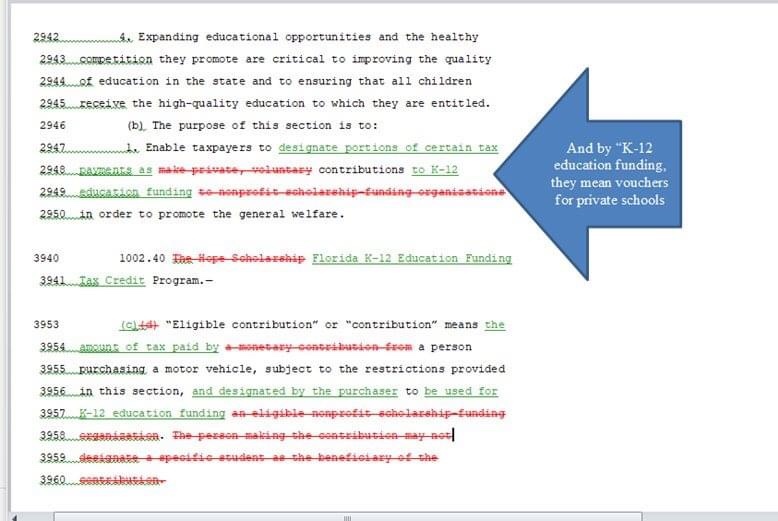
Please take a look starting at line 3953 of SB 48. When people go to buy a car, they will be asked if they want to divert their sales tax dollars to “K-12 Education Funding.”
What will they think their money is going to? Will they realize they are diverting their sales tax dollars to fund unaccountable private school vouchers and to fund the unregulated efforts of home school parents?

Link to SB 48: https://www.flsenate.gov/Session/Bill/2021/48

That’s not the only problem with SB 48 but it makes it obvious that the bill sponsor is trying to deceive the public.

This is our tax money! We want our tax money to go to HIGH QUALITY schools. Certainly a parent can choose to send their child to a subpar school but the taxpayer shouldn’t be forced to pay for it.

I am worried that this bill will take even more money from the already diminishing budget of the district run schools.

Our district-run schools need funds for wrap around services, libraries, art classes, music classes, team sports, civic classes, and high quality science classes. Of course until the pandemic is over, the district run schools are being forced to do virtual and brick and mortar.

Quote from a blog hosted by Step Up for Students:
Step Up for Students, which hosts this blog, uses 11 lobbyists, according to state records. “Everybody is trying to get a piece of the pie” …The new school voucher plan could be a test case for the new-look Florida Supreme Court. The plan draws from general revenue funds instead of tax credits. When a similar idea was enacted in 2006, the state Supreme Court struck it down as unconstitutional [because it gave money to religious organizations in violation of the state constitution that says adherents and philanthropists should fund religious institutions of their choice not taxpayers being forced to fund other people’s religious institutions]. But three of the justices who supported that decision are no longer on the court, having been replaced by justices who have previously supported voucher programs. Step Up For Students, which hosts this blog, helps administer the tax credit and other state scholarship programs. Link to the blog: https://www.redefinedonline.org/2019/03/florida-schools-roundup-education-lobby-vouchers-and-the-top-court-and-more

Another article about SB 48: https://lwveducation.com/category/florida/

Florida voters said NO to Amendment 8 in 2012 but then they keep electing representatives who pass bills in violation of our Florida Constitution. Hopefully SB 48 won’t pass. Info about the 2012 amendment 8 in case you don’t remember:
https://www.au.org/content/florida-amendment-8-0

New charter school being built across the street from an A rated neighborhood elementary school

1. Will River City Education Services, Inc be using our sales tax dollars to repay the loans that are funding the two new charter schools? They have two new charter schools approved by the school board:

***CHARTER SCHOOL CONTRACT FOR RIVER CITY EDUCATION SERVICES, INC., TO OPEN RIVER CITY SCIENCE ACADEMY INTRACOASTAL

*** CHARTER SCHOOL CONTRACT FOR RIVER CITY EDUCATION SERVICES, INC., TO OPEN RIVER CITY SCIENCE ACADEMY SOUTHEAST

2. Is it true that according to Florida statute 1002.33, the school board could not have denied these charter school applications? If the school board had wanted to deny the application but failed to win on appeal, then the school board would have been subject to this part of the statute:

The administrative law judge shall award the prevailing party reasonable attorney fees and costs incurred during the mediation process, administrative proceeding, and any appeals, to be paid by the party whom the administrative law judge rules against.

School board member answered: Yes, this is accurate

3. Are you worried that real estate investors are getting rich off the taxpayers? 

School board member answered: Yes 

4. Will these charter schools still be here after the half cent sales tax ends? 

School board member answered: We would not be able to predict this 

5. Or will they close and we’ll essentially lose our tax dollars? HB 7069 forced local school boards to share our property taxes with charter schools. Then in 2020, HB 7097 is forcing us to share our sales tax dollars with charter schools. Quote from this article:

The report also notes that nearly 400 charters in Florida have closed over the last couple of decades. What research went into this report, and why, in Integrity Florida’s view, have charters not succeeded in their mission?  

6. What can you do to mitigate the damage caused by charter schools closing? 

School board member answers: This will fall to the families that make choices about which schools to attend. 

7. Now that our sales tax money is going to the charter school industry, I fear charter schools are going to start popping up all over town.  What will that do to our excellent neighborhood schools that are loved by the parents. I guess if the parents don’t like their neighborhood school, then perhaps they’ll be happy for another option. But it’s going to be a sad day if millions of our sales tax dollars go to build new charter schools that subsequently close and there are no clawback provisions in place to recoup our sales tax dollars even if the charter school building is sold for millions to a private school or other private investor. 

School board member answered: This would be very sad and frustrating indeed. 

I sent the below email to my city council member but I have not received a response:
 

Honorable City Council Member Boylan,
I was told that even though the charter school didn’t have to apply for a zoning change, they did have to apply for a building permit. Approval should have been denied due to traffic congestion.  How do I find out who approved the building permit? 
Link to article about it: https://www.news4jax.com/news/local/2020/11/10/a-charter-school-is-being-built-across-the-street-from-a-public-school-some-arent-happy-about-it/
It doesn’t seem we can blame the school board for this. They have the least control over the funding and placement of charter schools. The majority on the city council by delaying the vote on the referendum and the majority state legislators for explicitly taking away the school board’s power to deny the application are to blame if you see a problem with a charter school building right across the street from an A rated neighborhood school. 
But if traffic is also an issue, then we can blame the person that approved the building permit?
Can we stop this charter school from building right across the street from an A rated public school on a two lane road where traffic is already an issue? If yes, how? And if it’s too late to stop this, how can we stop it from happening all over town now that the state legislators have forced us to give our sales tax dollars to charter schools?
Thanks,


References:

  1. Response from Dr. Greene forwarded to me from a friend:

The Oversight Committee is an independent body from the school district, and they have the autonomy to establish reporting requirements for public and charter schools. As a meeting of a governmental advisory body, there will be an opportunity for public comment, and I hope you will share your concerns there as well.

2. The latest RIVER CITY EDUCATION SERVICES, INC.  form 990 can be found at this link:

https://projects.propublica.org/nonprofits/organizations/205773949/201733319349300218/full

Excerpt from the Form 990:

Form 990, Part IX, Line 24e   INSTRUCTIONAL STAFF TRAINING  92,127

Form 990, Part IX, Line 24e   BOARD OF EDUCATION                     303,064

Form 990, Part IX, Line 24e   SCHOOL ADMINISTRATION           1,554,429

Form 990, Part IX, Line 24e   FACILITIES ACQ & RENT                1,158,065

Form 990, Part IX, Line 24e   FISCAL SERVICES                               339,272

Form 990, Part IX, Line 24e   OPERATION OF PLANT                      832,877

Form 990, Part IX, Line 24e   MAINTENANCE OF PLANT               154,098

Form 990, Part IX, Line 24e   COMMUNITY SERVICE                     327,143

Etc to a total of  $6,232,860 on line 24 e

3. Excerpts from an opinion piece from a couple of years ago:

Thanks to HB 7069 and other laws, the most profitable enterprise in the charter school industry is real estate. To see how this works, consider the case of River City Science Academy in Jacksonville. 

Link to article: https://www.news-press.com/story/opinion/contributors/2017/10/13/pushing-charter-schools-accountability/754658001/
A
nother article mentions it on page 184-185:  https://empireofdeceit.com/resources/pdf/Empire_of_Deceit_final.pdf

Letter to city council regarding 2020-627

To the City Council,

The state legislature has taken away the school board’s authority to safeguard our sales tax dollars going to the charter school industry. (ref 3) It is up to the city council to be diligent when voting on ordinances that are giving our sales tax dollars to the charter school industry. I urge the city council to vote no on 2020-627 as the money appears to be aimed at enriching real estate investors.

If the city council had not prevented us from voting on the sales tax referendum in 2019, our referendum would not have fallen under HB 7097 passed in 2020 which took away the school board’s ability to protect our sales tax dollars going to the charter school industry in addition to forcing us to give our sales tax dollars to charter schools on a per student formula instead of a needs basis.

Superintendent Greene (in an email I received in response to my inquiry) confirmed that in the event a charter school closes, our sales tax money (except for the money sitting in the bank) will be forfeited to the real estate investor. It is up to the city council to protect our sales tax dollars going to the charter school industry because the state legislature has taken away the school board’s authority.  

The City of Jacksonville’s Office of Economic Development and the Office of General Counsel negotiated the bond application (2020-627) with the Jacksonville Alliance for KIPP Schools. Based on the bill summary, they indicate that they will provide oversight and administration. 

The bond is outside the purview of the Duval County School Board. The city council needs to ascertain the legitimacy of the claim that KIPP’s “affiliates” and “any successor” and “McDuff QALICB2, Inc”  qualify as an educational institution for purposes of the bond. McDuff QALICB2, Inc and JAKS appear to me to be real estate investors.

A recent audit revealed that Kipp paid $850,000 in rent to JAKS in that audit year. (ref 6) This bond is being done partly to give money to Chartrand and Baker. (ref 1) Jason Gabriel’s office in 2019 interpreted “shall” to mean “doesn’t have to” in order to help the charter school industry including Chartrand and Baker or so it appeared to me. The city council and the school board need to be skeptical of the Office of General Counsel opinions when it comes to the profit motivated charter school industry.

I assume the bond will be repaid with lease payments funded by our sales tax dollars.. I continue to wonder if the voters understood that Jason Fischer co-sponsored HB 7097 which took away the school board’s ability to protect our sales tax dollars going to charter schools when they voted for him in the last election.

Please see references below which back up my fact claims. 

Begin forwarded message from school board member in response to my inquiry about the authority of the citizen oversight committee:

Hi Susan,

For you reference, the SB policy outlining the role and responsibilities of the Oversight Committee can be found here: https://dcps.duvalschools.org/site/handlers/filedownload.ashx?moduleinstanceid=12486&dataid=70317&FileName=Chapter%209%20-%20School%20Community%20Relations%20and%20Interlocal%20Agreements.pdf

 Policy 9.66

Please note that the Oversight Committee does not have the authority to approve or deny plans. They provide monitoring and oversight and then report findings back to the SB.

Charter schools may use their funds for any/all allowable uses defined in FL Statute. This is the same statute that Charters have already been using to guide Capital funds; this should be a familiar process for Charter schools.

As is current practice, the state essentially circumvents the local school board to provide direct oversight of the Charter school system and this process will not be an exception. If there is misuse this would be reported like any other discrepancy in spending of capital funds through the District to the State DOE.

I hope this is helpful.

———- Forwarded message ———

From: Susan
Date: Tue, Nov 24, 2020 at 1:39 PM
Subject: Has the state legislature left the local elected school board with any options to protect our sales tax money going to charter schools?
To: Senator Gibson <gibson.audrey.web@flsenate.gov>, <BEAN.AARON.WEB@flsenate.gov>, <clay.yarborough@myfloridahouse.gov>, <cord.byrd@myfloridahouse.gov>, <jason.fischer@myfloridahouse.gov>, <tracie.davis@myfloridahouse.gov>, <wyman.duggan@myfloridahouse.gov>, <angie.nixon@yahoo.com>

To the Duval Legislative Delegation,

I urge you to please pass a bill to provide protections for our sales tax dollars in the event the charter school receiving our sales tax dollars should close.

Are there any options for the local school board to put restrictions on the money going to charter schools? A charter school and its affiliates are seeking a bond which I assume they plan to repay with our sales tax money so this is an urgent question. Link to the ordinance that the city council will soon be voting on:  https://jaxcityc.legistar.com/LegislationDetail.aspx?ID=4663688&GUID=5172AF95-34C2-4EA5-B3CD-67405B8D9A31

1. Under state law, would the school board be allowed to require clawback provisions to recoup our sales tax dollars if the charter school closes or the building is sold?
2. The Oversight Committee must monitor the expenditures but do they have any authority to withhold funding? The Oversight Committee was an extra layer of protection that was included on our ballot. Our Duval ballot included the words:

“with expenditures based upon the Surtax Capital Outlay Plan, and monitored by an independent citizens committee”

References

1. Excerpt from an email I received from a city official regarding 2020-627:
Yes, the loans in (ii) and (iii) repay loans from Chartrand and Baker. 

2. Florida Statute 1013.62(4) A charter school’s governing body may use charter school capital outlay funds for the following purposes:
(a) Purchase of real property.
(b) Construction of school facilities.
(c) Purchase, lease-purchase, or lease of permanent or relocatable school facilities.
(d) Purchase of vehicles to transport students to and from the charter school.
(e) Renovation, repair, and maintenance of school facilities that the charter school owns or is purchasing through a lease-purchase or long-term lease of 5 years or longer.
(f) Payment of the cost of premiums for property and casualty insurance necessary to insure the school facilities.
(g) Purchase, lease-purchase, or lease of driver’s education vehicles; motor vehicles used for the maintenance or operation of plants and equipment; security vehicles; or vehicles used in storing or distributing materials and equipment.
(h) Purchase, lease-purchase, or lease of computer and device hardware and operating system software necessary for gaining access to or enhancing the use of electronic and digital instructional content and resources; and enterprise resource software applications that are classified as capital assets in accordance with definitions of the Governmental Accounting Standards Board, have a useful life of at least 5 years, and are used to support schoolwide administration or state-mandated reporting requirements. Enterprise resource software may be acquired by annual license fees, maintenance fees, or lease agreement.
(i) …

3. The legislature forced us to give our sales tax dollars to charter schools on a per student basis with HB 7097.  It begins on line 1291:
https://www.flsenate.gov/Session/Bill/2020/7097/BillText/er/PDF
Quote from the bill HB 7097 beginning at line 1332:

Surtax revenues shared with charter schools shall be expended by the charter school in a manner consistent with the allowable uses set forth in s. 1013.62(4). All revenues and expenditures shall be accounted for in a charter school’s monthly or quarterly financial statement pursuant to s. 1002.33(9). The eligibility of a charter school to receive funds under this subsection shall be determined in accordance with s. 1013.62(1). If a school’s charter is not renewed or is terminated and the school is dissolved under the provisions of law under which the school was organized, any unencumbered funds received under this subsection shall revert to the sponsor. [inadequate clawback provisions for encumbered funds]

4. Florida statute 1013.62(1) (a) To be eligible to receive capital outlay funds, a charter school must:
1.a. Have been in operation for 2 or more years;
b. Be governed by a governing board established in the state for 2 or more years which operates both charter schools and conversion charter schools within the state;
c. Be an expanded feeder chain of a charter school within the same school district that is currently receiving charter school capital outlay funds;
d. Have been accredited by a regional accrediting association as defined by State Board of Education rule; or
e. Serve students in facilities that are provided by a business partner for a charter school-in-the-workplace pursuant to s. 1002.33(15)(b).
2. Have an annual audit that does not reveal any of the financial emergency conditions provided in s. 218.503(1) for the most recent fiscal year for which such audit results are available.
3. Have satisfactory student achievement based on state accountability standards applicable to the charter school.
4. Have received final approval from its sponsor pursuant to s. 1002.33 for operation during that fiscal year.
5. …

5. The bond is getting money to repay Chartrand and Baker for the money they loaned Kipp AND to build a new charter school on Golfair.  I am indeed making the assumption that this bond is going to be repaid with our sales tax money based on the way the ownership of previous buildings were structured and the wording in 2020-627. I believe the following

  • 1. the bond money will go to repay Chartrand and Baker and to build a new charter school
  • 2. the building will be owned by a real estate investor
  • 3. KIPP will use our sales tax money to rent the space from the real estate investor

Here is the link to the 990 for  MCDUFF QALICB 2 https://projects.propublica.org/nonprofits/organizations/474726810/202040239349301004/full The reason I call them a real estate investor is because they describe themselves on their form 990 as follows: “Briefly describe the organization’s mission or most significant activities: HOLD, DEVELOP AND MAINTAIN, AND RETAIN FINANCING AS NEEDED FOR THE REAL ESTATE…”

Here is the link to KIPP where they say they expect to pay $1,163,370 in rent to JAKS and McDuff QALICB 2 in 2020: https://www.kippjax.org/wp-content/uploads/2019/12/FY-2020-Budget-KIPP-Jacksonville-Schools.pdf

Here is the link to KIPP 2019 audit: https://www.kippjax.org/wp-content/uploads/2019/12/KIPP-JACKSONVILLE-K-8-SCHOOL-FINAL-2019_AUDIT.pdf Especially interesting is page 25 and 26.

6. Link to KIPP audit: