School board elections are important. Many times the races are decided in August in Duval County.
NPR’s First Coast Connect invited all DCPS board candidates on the show.
Here’s the two interviews of the candidates for DCPS district 1.
The interviewer asked Nadine this question:
An organization that has endorsed Tony Ricardo has the mission statement that they believe God has created government to punish evil and protect the good. What are your opinions about that?
I wonder why the interviewer didn’t ask Tony that same question. The mission statement has a vibe of Christian Nationalism or other militant religious organization that aims to use the government to punish based on religious doctrine. Shouldn’t she have asked Tony about that since the organization endorsed him?
She asks Dr. Ebri that question after the 8 minute mark in this video:
Please notice that Dr. Ebri promotes computer literacy, not teaching DEI as Tony Ricardo claims in the below interview. Dr. Ebri alludes to some of the racist and sexist remarks that Tony has said on FB but declines to repeat them. Yasmine calls in about them, but she also declines to repeat them on the air. You can see them in the Tributary article.
The interviewer in the below interview doesn’t challenge Tony by saying, “she didn’t say on my show that she wanted DEI classes; she said she wanted more STEM classes.” The interviewer also doesn’t challenge Tony when he says he’s opposed to DEI (diversity, equity, and inclusion). He says he is opposed to quotas, but that doesn’t answer the question.
Here’s the segment with Tony:
Please notice Tony’s comment about the assassination attempt where he claims that DEI is why the assassin wasn’t spotted earlier. Here’s a link to some facts to counter Tony’s claim. The article/podcast includes the proposition that the secret service is understaffed.
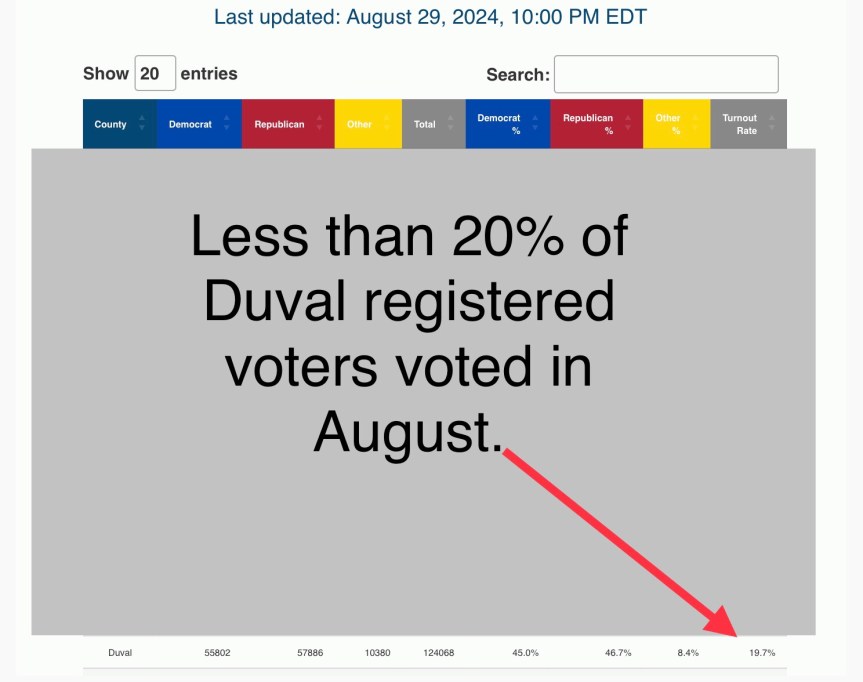
Tony Ricardo won the race and will represent District 1. Why do you think less than 20% of Duval registered voters voted in August? Why do some NPAs still think they can’t vote in the August school board election? I wish more people read the below article back in August. I think it would have motivated District 1 voters to get out and vote for Nadine.
The below article exposes Tony’s bigotry, but did voters read it?
64DER21-15 is a new rule from the newly appointed head of the Florida Department of Health. Governor DeSantis appointed Ladapo, but the state senate has not yet confirmed him. As you read this, please consider if you’d like to ask your state senator to vote no on Dr. Ladapo’s confirmation.
The new rule also says, “64DER21-15 repeals and replaces rule 64DER21-12 that was adopted August 6, 2021.”
Under the section called “specific reasons“, 64DER21-15 notice says “the Department observed no meaningful difference in the number of COVID-19 cases in school-aged children in counties where school districts have imposed mask mandates…” On what is Dr. Ladapo basing that statement? He indicates no study or data to support that claim. Is he basing that statement on data pre-delta variant? What would be his conclusion if masking was the only option of these four:
Chalkbeat dove back into the research. In short, existing studies focusing on schools — including those cited on both sides of the debate — are strikingly limited. Little if any research has definitively shown what effect masks have on COVID spread in schools. At the same time, there is a broader body of evidence collected in other settings that suggests that masks help prevent the spread of respiratory diseases like COVID-19. That appears to be what’s driving health authorities to recommend masking in the classroom, alongside a general desire to minimize the risk to children and communities when cases are rising. “It’s entirely possible that open windows or fresh-air ventilation accounts for nearly all the mitigation benefit in a classroom and other ‘layered’ interventions may contribute only a marginal benefit or none at all,” concludes Zweig. In fact, it’s not clear that any of the most cited studies examining masks in schools are able to pin down cause and effect. “All of the studies that I have seen,” said Tulane University epidemiologist Susan Hassig, “are not sufficiently rigorous to assess the actual effectiveness of masks” in schools. Some experts say we should look beyond research on masking in schools and keep the basic logic of masking in mind. COVID-19 “is transmitted predominately by inhalation of respiratory droplets generated when people cough, sneeze, sing, talk, or breathe,” explains the CDC. The logic of masks, then, is straightforward. They can block particles, protecting the wearer and limiting transmission from an individual who has the virus. Masking is particularly important for a disease like COVID-19 where an infected individual can transmit the disease before developing symptoms (and thus realizing they should stay home). Laboratory simulations confirm that masks stop many — though not all — of these droplets that could contain the virus. Jeremy Howard, author of a review of masking research and a research scientist at the University of San Francisco, says the benefits of masks very likely apply in school. “For masks in schools, the weight of evidence, when you combine it all together, is very strong,” he said. Mike Smith, a pediatrics professor and epidemiologist at Duke said “We have to make decisions weighing the risks and benefits without the gold standard randomized-controlled trial data.” Ultimately, Sarah Bode, a pediatrician in Columbus, Ohio argues, masks will help keep schools open during the delta surge, and the benefits of in-person school outweigh any downsides of masking.
Elected school boards only make rules for the district-run schools. Charter school boards will be making the rules for their schools. Some Florida state laws apply to both and some only apply to district-run schools. However, I think most people agree district-run and charter schools are considered “public schools” but I keep making the plea that the term “public schools” is outdated since the advent of charter schools and voucher funded private schools. Should public schools mean any school that receives public funds? When people use the term “public schools,” are they being intentionally vague?
64DER21-15 is called “Protocols for Controlling COVID-19 in School Settings.” Can’t we assume that means all schools?
Item (1) of 64DER21-15 does use the term “public schools” so I assume everyone will agree it applies to the district-run and the charter schools. I make the case that it also applies to voucher funded private schools because of Florida Statute 1002.421 which says:
.A private school participating in an educational scholarship program established pursuant to this chapter must … be in compliance with all requirements of this section …(g)Meet applicable state and local health, safety, and welfare laws, codes, and rules…
Items (2) and (3) of 64DER21-15 definitely seem to apply to ALL schools, even private schools that don’t receive government funding.
Why is the state Board of Education only going after the district-run schools? Are they even asking what protocols charter and voucher funded private schools are following? Are they threatening to reduce the funding of charter and voucher funded private schools that follow CDC guidelines? The 4 out of the 7 Duval county school board members are merely trying to follow CDC guidelines. Ladapo’s new rule is NOT following CDC guidelines. I agree with the counties that say the Florida Health Department shouldn’t have the authority to tell the Constitutional Officers (the elected school boards) to NOT follow CDC guidelines. It’s outrageous!
When people use the term “public schools,” are they being intentionally vague? What did “public schools” mean when Article IX of our Florida Constitution was last amended? I’ve heard many people say “charter schools are public schools” but they don’t have to follow all the rules set by district school boards. My memory tells me that charter schools have only been in Florida for 20 years. I’m not sure when the state legislature started giving vouchers to help cover the cost of private school tuition.
ARTICLE IX of Florida’s Constitution
SECTION 1. Public education.—(a) The education of children is a fundamental value of the people of the State of Florida. It is, therefore, a paramount duty of the state to make adequate provision for the education of all children residing within its borders. Adequate provision shall be made by law for a uniform, efficient, safe, secure, and high quality system offree public schools that allows students to obtain a high quality education and for the establishment, maintenance, and operation of institutions of higher learning and other public education programs that the needs of the people may require. To assure that children attending public schoolsobtain a high quality education, the legislature shall make adequate provision to ensure that, by the beginning of the 2010 school year, there are a sufficient number of classrooms so that …
The tricky question is: Should our elected school board fight back like the Leon County School Board did?
Excerpt from article:
After a lengthy debate, the Leon County School Board denied a new charter school’s application during Tuesday night’s board meeting. Scott Mazur, president of the local teacher’s union, said the charter’s application had “certain things that were missing.” George Levesque, attorney for the proposed school, said he hoped the board would consider “the recommendation made by your own staff — that the charter should be approved [despite the concerns].” Among several concerns laid out by staff was how the school would maintain a safe school officer, required by law [for both district run and charter schools].
I encourage the school board to adopt a policy that states that they will deny all charter school applications that do not include the following: * Give assurance that the charter school will accept and have adequate support for ESE students * Fully explain the charter school’s plan to comply with the state law that requires a school safety officer with a gun to be at the school. Do they plan to allow teachers to be armed which the school district doesn’t allow for the district run schools? * When the charter school closes, the building purchased or constructed with taxpayer dollars (either directly or indirectly via lease payments) must be leased to another charter school or allow the school district to share in the sales proceeds to recoup the tax money if the building is sold. After all, if the charter school is planning to fund the purchase with our sales surtax dollars, the school district should be able to have the ability to recoup our sales surtax dollars. Apparently the FLDOE thinks that also.
My guess is that most taxpayers don’t want our sales surtax money to fund the purchase of a school building that will later be sold to a private school for the purpose of enriching private real estate investors.
I asked the FLDOE these questions and here are the responses I received:
1. Is there any provision to pay the taxpayer back if the building is sold? Their answer:
Section 1013.62 (4) F.S. states, “If a charter school is non-renewed or terminated, any unencumbered funds and all equipment and property purchased with district public funds shall revert to the ownership of the district school board. The reversion of such equipment, property, and furnishings shall focus on recoverable assets, but not on intangible or irrecoverable costs such as rental or leasing fees, normal maintenance, and limited renovations. The reversion of all property secured with public funds is subject to the complete satisfaction of all lawful liens or encumbrances. If there are additional local issues such as the shared use of facilities or partial ownership of facilities or property, these issues shall be agreed to in the charter contract prior to the expenditure of funds.”
2. Do related party rules apply so that our sales surtax money can ONLY be used (directly or indirectly via lease payments to a related party) on items mentioned in 1013.62(4)? In other words, can related parties use our sales surtax money to repay loans? It seems that charter schools are setting up related party entities to skirt the rules of 1013.62(4) that bar capital outlay funds from being used to repay loans. Is that legal? Their answer:
The sponsor has fiduciary responsibility as it holds the contract with the governing board of the charter school.
References I’m focusing on one charter school as an example but many of these facts can be applied to other charter school applications.
Jacksonville Classical Academy (K-6) with the FLDOE school number165831 hasn’t been in existence for two years so it has not yet begun to get the FLDOE capital outlay funds detailed on this website: http://www.fldoe.org/finance/fco/charter-school-capital-outlay/
Jacksonville Classical Academy (which is part of the national charters getting their curriculum from Hillsdale College) got another Charter school approved May 4th by the school board. And apparently the charter school plans to move into a facility that housed a private school that closed in 2019. Excerpt from a document about the charter school’s application found on the school board’s website.:
“The school will be located in the Arlington area at 5900 Fort Caroline Road, Jacksonville, FL 32277.”
This article mentions that many of the students that attended the private school that closed (and is apparently the proposed location of the new charter school) were at least partially funding their tuition with McKay (for ESE students) vouchers. Excerpt from this 2019 article:
The principal of a Christian school in Arlington said financial issues due to low enrollment will force it to close its doors May 31 — the end of the current school year. Arlington Community Academy has been open for two years, opening as a kindergarten through third grade, and then adding a fourth grade this year. “He made a commitment to us that he would keep this school open for the Arlington community and he’s not doing that,” the unnamed parent said. “Within three years, he’s shutting down and he’s not telling us nothing.” “Enrollment is critical to maintaining operations,” Principal Gina Fafard wrote. “Despite our best efforts, enrollment has been significantly lower than expected, and we are not able to keep ACA operational beyond the end of the 2018-2019 school year.”
I assume real estate investors will buy the facility and lease it to the charter school because that’s usually what happens. The charter school will make the lease payments with our sales surtax dollars and other tax dollars. Will the real estate developers sell the property back to a private school after they get our sales surtax dollars for several years? The Jacksonville Classical Academy on 2043 Forest St., 32204 leases its building from JEB Jacksonville Support Corporation. Details of that real estate investor group: https://opencorporates.com/companies/us_fl/N19000011884
Quote from this November 2020 opinion piece published after the sales tax referendum was passed:
Rood said that Jacksonville Classical Academy will benefit from the recent half-cent sales tax referendum. Funds will be used to build a gym and free the school from some fundraising.
I see that the new KIPP school is requesting to be designated as a feeder school so it can get our sales surtax money BEFORE the two year probation period. Will this new charter school attempt to be designated as a feeder school also?
Anyone want to comment about Critical Race Theory and the propaganda pamphlet I received from Hillsdale College? Excerpt I received from a public request I sent to Jacksonville Classical Academy:
Jacksonville Classical Academy (JXC) has been supported through the early stages of startup by the Barney Charter School Initiative (BCSI) of Hillsdale College. Jacksonville Classical Academy is a Licensed User of the Hillsdale College K-12 Curriculum.
A recent spate of charter-school closings illustrates weaknesses in state law. Florida requires local school districts to oversee charter schools but gives them limited power to intervene when cash is mismanaged or students are deprived. Lack of regulation can allow abuses. … A handful of South Florida charter schools that failed in the past five years owe a total of at least $1 million in public education money to local school districts, records show. The actual amount may be much higher. Districts struggle to track spending at troubled schools.
When I asked the FLDOE if these were PECO funds of which I believe the district run schools got zero, this was the response:
Per the 2020 General Appropriations Act, Chapter 2020-111, specific appropriation 21, these capital funds are from the Public Education Capital Outlay and Debt Service Trust Fund (state funds).
These Duval County charter schools received capital outlay funds from the state every month this year. The amount received for April:
April
Name of charter school
15,090
160471
LONE STAR HIGH SCHOOL
8,338
160531
DUVAL MYCROSCHOOL OF INTEGRATED ACADEMICS AND TECHNOLOGIES


 Unite Us Do Not Divide Us